Google I/O 2026: the agentic era — what to watch, what to ignore
FaktumAI analysis of Sundar Pichai's Google I/O 2026 keynote: agents, Gemini 3.5 Flash, search as a platform — and what it means for Finnish teams.
What happened?
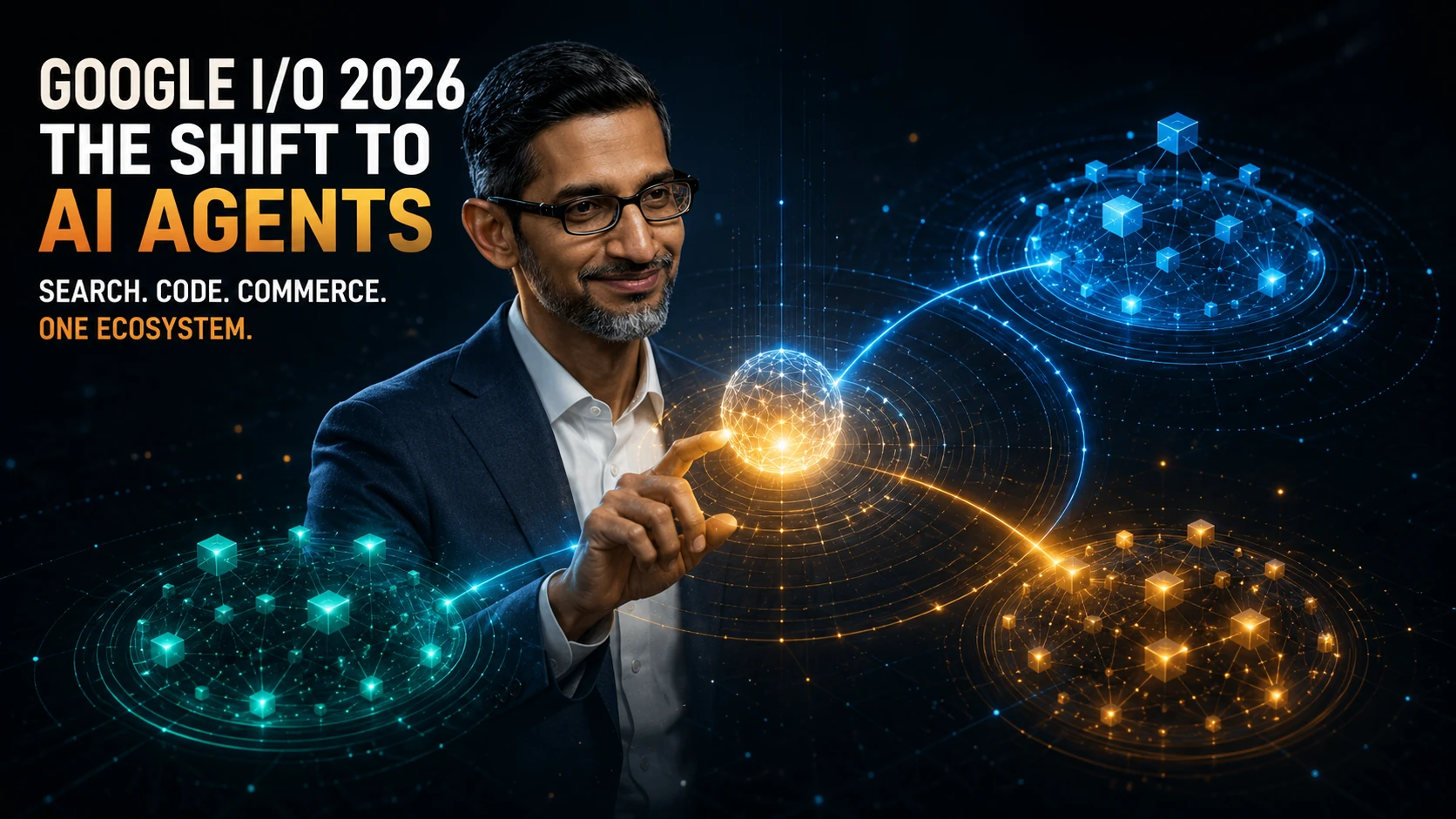
On 19 May 2026, Sundar Pichai opened Google I/O with a familiar thesis turned operational: AI is moving from answering to acting. The keynote was not one moonshot announcement but a coordinated stack — Gemini 3.5 Flash, Anti-Gravity 2.0, Gemini Spark, generative UI in Search, and agent commerce (Universal Cart, UCP, AP2).
Demis Hassabis highlighted world models (Gemini Omni, AGI “a few years away”) and science pipelines. The business story, however, is platform lock-in through agents — the same agent harness across Search, consumer products, and developer tools.
FaktumAI perspective: This is Google’s answer to the OpenAI growth wedge — not by out-hyping a lab, but by shipping agents where Google already has distribution: Search, Android, Workspace, and Cloud.
Key figures
3.2 quadrillion/mo
AI usage across Google services
Tokens = text units models process. Volume grew 7× in one year (I/O 2025: 0.48 quadrillion).
$180–190 bn
Hardware and data center spending (2026)
CapEx = capital spending on servers and chips. Six times higher than in 2022 ($31 bn).
900M+
Gemini app monthly users
Monthly active users (MAU). More than doubled from 400 million in under a year.
4× faster
Gemini 3.5 Flash — response speed
Four times faster than other top-tier models; up to 12× in the Anti-Gravity dev environment.
8.5M+/mo
Developers using Google AI models
App builders using Google's models each month via APIs or dev tools.
1B+/mo
AI Mode search users
Monthly users of Google's AI-powered search — its biggest search AI upgrade to date.
Revolutionary or incremental?
Neither a nothing-burger nor a paradigm flip. The genuinely new layer is persistent, background agents with tool access:
| Layer | What shipped | Novelty |
|---|---|---|
| Models | Gemini 3.5 Flash (now), 3.5 Pro (next month), Omni (video/world) | Flash = speed + cost; Omni = media pipeline |
| Dev | Anti-Gravity 2.0 desktop, CLI, SDK, sub-agents | Agent-first IDE globally today |
| Consumer | Gemini Spark (24/7 VM agent), Daily Brief | US beta first; MCP integrations coming |
| Search | Search agents, generative UI, unified AI search box | Search as runtime, not index |
| Commerce | Universal Cart, UCP, AP2 payment mandates | Open standard play with Amazon, Stripe, etc. |
| Hardware | Project Aura audio glasses (fall 2026) | Gemini in ear; iOS + Android |
What is structurally significant: Google embeds the same agent harness (Anti-Gravity) in Search, Spark, and developer tools. A query can spawn code, deploy UI, and monitor the web — the OS demo (Doom on agent-built kernel) was theater, but the pattern is the product strategy.
Market and power dynamics
Three shifts matter for the industry map:
-
Full-stack winners pull ahead. Custom TPUs (8th gen, 1M+ training scale), models, Search, Wallet, and Cloud in one capex story. Competing on models alone gets harder.
-
Standards as moats. SynthID adoption by OpenAI, NVIDIA, and others is notable — transparency infrastructure becomes a coordination game. Google tries to own the verification layer (Search + Chrome: “was this generated with AI?”).
-
Agent commerce protocols. UCP (Universal Commerce Protocol) and AP2 (payments with digital mandates) aim to be HTTP-for-shopping. Founding partners include Amazon, Meta, Microsoft, Salesforce, Stripe. If UCP sticks, distribution moves from websites to agent surfaces — bad news for SEO-only businesses, good for catalog + API-ready merchants.
OpenAI is not displaced; Google is redefining the battlefield to owned surfaces. Microsoft’s enterprise wedge (Copilot + Azure + M365) remains; Google pushes consumer habit + Search + Android.
What it means for Finland
Direct consumer impact: limited for now. Spark beta, Universal Cart, Ask YouTube, and several agent-commerce pieces are US-first or US this summer. Finns already use Gemini and AI Mode globally, but the action-taking agents arrive late.
Indirect impact: real and immediate for builders and buyers:
| Audience | Effect | Suggested reaction |
|---|---|---|
| Developers | Anti-Gravity 2.0 + 3.5 Flash API available globally today | Benchmark Flash vs current stack; test sub-agent patterns |
| GCP / Workspace customers | Faster/cheaper inference narrative; agent features in Google stack | Revisit token budgets and model mix before Q3 renewals |
| Public sector & regulated firms | Spark runs on dedicated Google Cloud VMs with Gmail/Calendar access | Treat as high-risk processing under GDPR; DPIA before pilots |
| Retail / e-commerce | UCP/AP2 may reshape discovery and checkout | Monitor Nordic rollout; don’t rebuild checkout yet |
| Media / SEO | Generative UI + search agents reduce click-out traffic | Diversify beyond classic blue-link SEO |
Finland does not need a national emergency response. It needs architecture hygiene: agent permissions, logging, human-in-the-loop for payments, and not locking procurement to demo-tier US features.
Technical assessment for builders
Listen to:
- Gemini 3.5 Flash as default — Pichai claimed 4× faster output than other frontier models and under half the price, with an illustrative $1B+/year savings if large GCP customers shift 80% of token volume to Flash.
- Anti-Gravity 2.0 — sub-agents, async tasks, MCP; Google’s answer to Cursor-style agent IDEs, now a standalone desktop app.
- MCP integration in Spark — third-party tools “in coming weeks”; aligns with industry agent wiring.
React to:
- Run a two-week eval: Flash for high-volume tasks, keep Pro-class models for reasoning-heavy jobs.
- If you ship on Google Cloud, model cost per outcome, not cost per token — agent loops multiply usage (token austerity applies here too).
- For EU customers, document what runs on whose VM when agents touch mail, calendar, or payments.
Ignore (for now):
- AGI/singularity closing rhetoric — not actionable.
- Doom-on-agent-OS stunt — marketing for developer mindshare.
- Smart glasses until Nordic availability and privacy review.
Risks and uncertainties
- Benchmarks and demos are Google-curated; independent Flash evals in Finnish workloads are still sparse.
- Agent safety — Spark rolls to “trusted testers” first; autonomous email, calendar, and future payments need abuse-case testing.
- EU AI Act + GDPR — personal intelligence connecting Gmail, Photos, Calendar triggers familiar data-minimization questions; Finnish DPOs will ask where inference runs and what is retained.
- Publisher economics — search agents that synthesize and act may reduce referral traffic; Google argues agents surface “hyper-relevant” creator content — unproven at scale.
- US-centric rollout — Finnish consumers may read headlines and assume Spark is here; manage expectations internally.
Conclusion
Google I/O 2026 confirms the industry’s direction: agents on platforms that already have users. There is no single Finnish “Google moment,” but there is a ** procurement and engineering moment** — Flash economics, Anti-Gravity tooling, and upcoming search-agent distribution deserve attention this quarter.
Do not panic. Do not ignore. Update your model mix, agent governance, and SEO/commerce assumptions. Watch whether UCP becomes real infrastructure or another consortium slide deck.
Solo developer perspective
Good: Gemini 3.5 Flash and Anti-Gravity 2.0 are available now — a solo developer can test cheaper inference and agent tooling without an enterprise contract. MCP support is coming to Spark; the same tool-wiring pattern works in other agent IDEs. Agent thinking (loops, sub-tasks, tool calls) is a transferable skill, not a Google-only feature.
Bad: Consumer agents (Spark, cart checkout, Ask YouTube) are not in Finland — do not build a side project on them. Keynote numbers (speed, savings) are Google’s own comparisons; run your own benchmark on your data before switching production stacks. Cheap per-token pricing does not help if an agent runs dozens of calls — the bill can still rise.
Worth learning: Run a two-week Flash trial on your own tasks (code, docs, batch processing). Measure price per finished outcome, not per API call. Try Anti-Gravity or MCP on one project — learn the limits (where you trust the agent, where you do not). Do not buy the hype: AGI rhetoric and demo OSes do not change daily work, but a cheaper model plus better agent tooling might.
For the broader AI financing picture, pair this with structural bubble analysis and OpenAI’s compute wedge.
Sources
- 1. Google I/O '26 Keynote (Sundar Pichai) — Google / keynote transcript, 2026-05-19
- 2. Google I/O 2026 keynote in 35 minutes — Summary transcript, 2026-05-19
FaktumAI note: This article is based on the listed sources. Points that could not be verified from an independent source are marked as uncertain.