AI productivity crisis: Gartner, layoffs, and the upskilling gap
FaktumAI analysis of Natasha Bernal's Tech Report interviews — why AI layoffs don't improve ROI, Meta surveillance backlash, and what employers miss on workforce planning.
What happened?
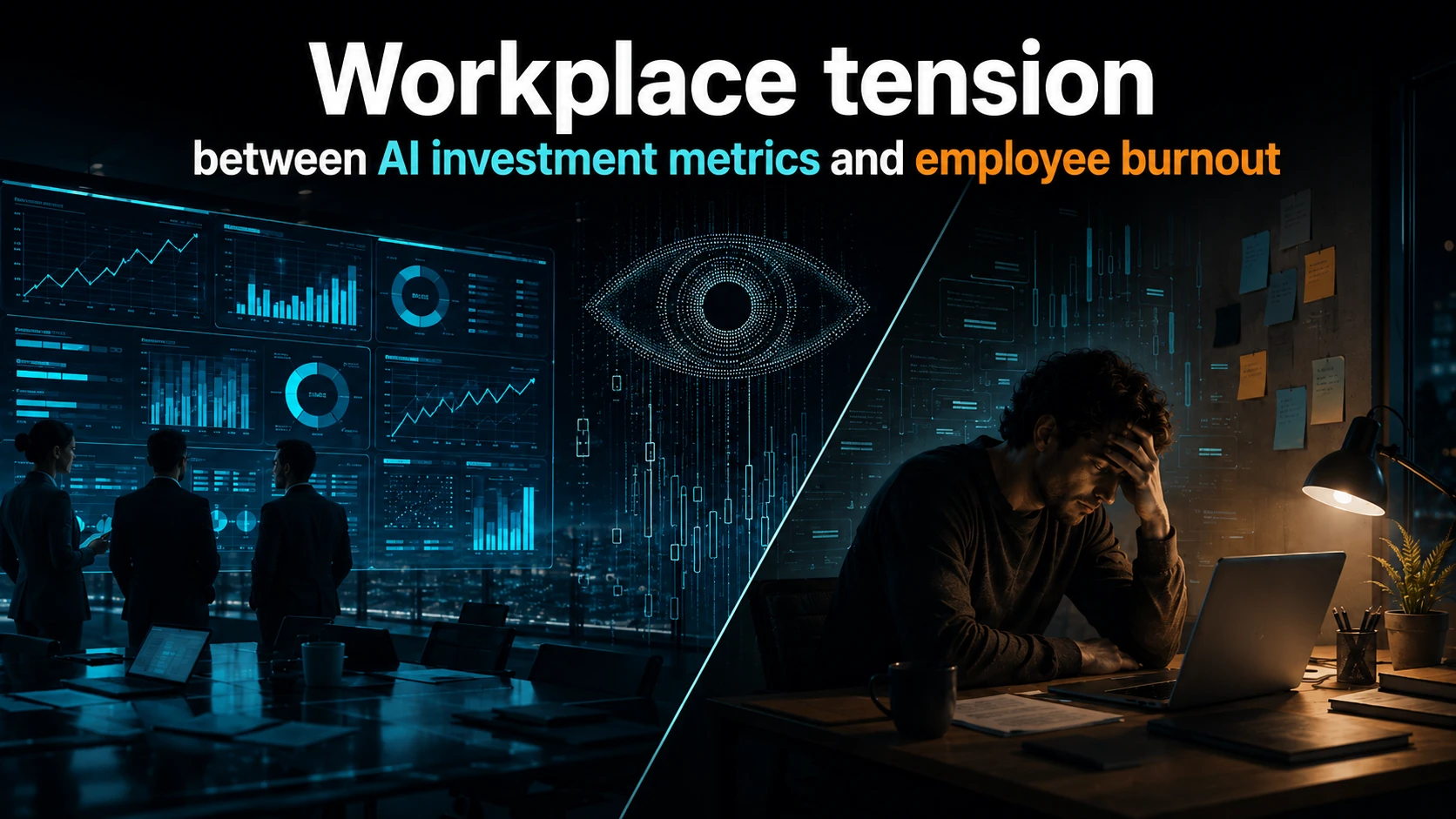
In two May 2026 Tech Report episodes, Natasha Bernal — an award-winning British tech journalist and commentator based in London — connects the same thread from different angles: companies are buying AI and cutting people without a workforce plan — and the result is not the promised productivity dividend but burnout, performative work, and resistance.
The 13 May episode focuses on Meta: employees posted protest flyers after mouse-tracking, keystroke monitoring, and screenshot capture — surveillance framed as training data for workplace AI — ahead of roughly 10% layoffs. Bernal ties this to Gartner research on ~350 global billion-dollar firms: executives who cut staff after AI adoption saw zero financial gain versus peers who kept employees through rollout. Firms with high AI ROI (return on investment — how much profit AI spending actually yields) are not, in Gartner’s framing, the same firms reporting large workforce reductions.
The 20 May episode widens the lens: a newer Gartner line argues that from 2028 onward, AI may create more jobs than it eliminates — but only if companies invest in upskilling and deliberately map future skills. Bernal is skeptical most firms are doing that. She cites BCG (Boston Consulting Group) April 2026 report: 50–55% of US jobs could be reshaped in two to three years — same title, radically different expectations. Workers face AI quotas, AI-influenced performance reviews, and a shift from “do the job well” to “justify the AI budget.” Gallup data (cited): only 18% of people aged 14–29 feel hopeful about AI.
FaktumAI perspective: This is not about a single company — it is a structural mismatch — capital flowing into AI while human capital planning lags. Bernal’s interviews are a useful signal; verify Gartner and BCG primary reports before treating numbers as board-ready.
Key figures
~350 firms
Gartner study sample
Global companies with $1B+ revenue surveyed on AI adoption and layoffs
Zero
Financial gain after AI + layoffs
Versus companies that kept employees during AI rollout (Gartner, per Bernal)
50–55%
US jobs reshaped by AI
BCG (Boston Consulting Group), April 2026 — same role, radically new expectations in 2–3 years
18%
Young adults hopeful about AI
Gallup survey, ages 14–29 (Bernal cites rising negative views)
62%
Amazon workers: HR feels automated
Fast Company magazine (US business and workplace media), productivity episode
~10%
Meta: layoffs (2026)
Roughly one in ten employees — at the same time as mouse and keystroke monitoring rollout
Why this matters for the Finnish reader
Finnish employers often run smaller pilots — Copilot, Gemini, custom GPTs — with procurement and DPO review but without a published reskilling plan. If Gartner’s pattern holds globally:
- Public sector and enterprise IT may face pressure to “do AI” while headcount is frozen — the worst of both worlds.
- EU AI Act high-risk categories include employment-related AI; algorithmic performance management is not a US-only issue.
- Remote and hybrid norms in Nordic tech make surveillance tooling culturally toxic — talent exit may hurt more than in US HQs.
- Union density is higher than in US big tech; backlash may show up as policy and collective bargaining, not flyers alone.
Layoffs are not an AI ROI strategy
Executives have justified layoffs with AI investment for roughly two years. Bernal argues that Gartner’s research is the first strong number-based comparison that challenges that story: “We invested in AI, therefore we need X% fewer people.”
| Narrative | What Gartner framing suggests (per interviews) |
|---|---|
| Cut staff → fund AI → profit | No measurable financial gain vs keeping staff |
| High AI ROI companies | Overlap weak with firms reporting large reductions |
| Short-term cost massage | Layoffs may not correlate with autonomous-ops outcomes |
Bernal ties this to an earlier episode of the same show. The logic is contradictory: on one hand, leaders claim AI delivers massive efficiency gains; on the other, they lay off the people who know the business. When experienced staff leave, tacit company knowledge goes with them — processes, client relationships, and lessons from past mistakes. That is institutional memory, and it was already a theme in a prior Tech Report episode.
Jevons paradox means, in simple terms: when something gets more efficient, people often use it more, not less. In the 1800s, more efficient coal burning did not cut jobs — demand grew and new work appeared.
Some AI debates apply the same logic forward: efficiency will eventually create new jobs, not just remove old ones. Bernal is cautious. In her view, AI returns are not strong enough yet to show that phase is already underway — more jobs later are possible, but layoffs now are not supported by current evidence.
The productivity crisis employers are building
Bernal’s headline claim: executives who deploy AI without upskilling plans risk a “huge productivity crisis.”
Mechanisms she describes:
- Bolt-on AI — tools deployed without rethinking workflows or skills.
- Rising workload — research she references suggests AI often adds work; “freeing you for interesting tasks” can mean only hard tasks, all the time → burnout.
- Performative work — employees meet AI usage quotas or metric targets instead of delivering outcomes; gaming Teams status and keystroke counters is the modern version.
- Evaluation shift — promotion criteria move from client outcomes or craft skill to proving Copilot/ChatGPT moved a metric — criteria vary wildly by org and feel “rigged” to workers.
- Missing ladder — junior tasks automated away without replacing on-the-job training for newcomers.
Gartner’s forward view (2028+) — AI creates net jobs if CHROs deprioritize obsolete skills and build critical ones deliberately — sounds rational. Bernal doubts those conversations happen in most boardrooms.
Employer surveillance software (bossware): Meta as the visible case
Bossware is software that monitors employees: mouse movement, keystrokes, screen captures, or even cameras. The employer measures how actively and quickly work gets done — and often decides consequences too.
Meta illustrates a dual track Bernal sees across tech:
| Track | Employee experience |
|---|---|
| Productivity AI | Meta first encouraged trying its AI tools — now daily use is expected |
| Surveillance AI | Mouse movement, keystrokes, and screenshots collected to build and sell workplace AI |
Employees reportedly drew a line: helping build products is one thing; becoming training data under surveillance is another. Flyers are low-friction protest — not a union vote — but Bernal expects more resistance, talent exit, or quiet quitting (“cash checks until the next layoff round”).
The alleged benefit of these surveillance tools — detecting burnout from language or facial cues — is theoretical. In practice, Bernal argues, bossware is used to penalize: bell-curve ranking, automated performance flags, Kafkaesque disputes when the model is wrong and no human can override the dataset.
Ride-hailing and courier precedents (mis-identification, no appeal) scale to the office when HR and scheduling are automated — according to Fast Company magazine (US business and workplace media), 62% of Amazon workers felt HR interactions were automated when they needed human help.
Generational backlash and frontier AI lab blind spots
Labs here means the teams building frontier models — OpenAI, Google DeepMind, and similar AI research organizations, not physical science laboratories.
Bernal notes commencement booing of AI boosterism (e.g. speeches framing AI as the next industrial revolution) and Eric Schmidt’s “agency” framing at Arizona — read charitably or as passing responsibility to graduates for problems incumbents built.
Gallup: only 18% hopeful among 14–29 — contradicts the assumption that “young people will lead AI adoption because they’re digital natives.” She argues it is unfair to expect interns to “stage the rebellion”; seniors should set tone.
Bernal finds executives’ surprise odd. She compares it to a tobacco seller wondering why people hate smoking — the answer is obvious. Likewise: when AI touches layoffs, surveillance, and opaque decisions, pushback is predictable, not mysterious.
Technical assessment for Finnish teams
For engineering and product leaders:
- Separate tool rollout from people policy. Copilot/Gemini licenses without time budget for learning produce quota theater.
- Document human override paths before any AI-assisted performance or scheduling tool — EU AI Act employment use cases need audit trails.
- Measure outcomes, not token clicks. If a KPI (key performance indicator) requires only “AI usage hours,” expect performative prompts, not better software.
- Pilot with retained headcount — Gartner framing in the interviews favors optimize with people, not replace then hope.
- Employee surveillance is a security and trust risk. Keystroke and screen monitoring is not a light productivity feature — treat it as a serious privacy and culture decision.
For individual contributors:
- Find out what you are graded on. Compare this quarter’s criteria with last year. If showing AI usage replaced craft skill, adjust your plan accordingly.
- Keep your own notes. When an algorithm logs attendance or output, the employer has an automatic record — you do not. You need your own paper trail in disputes.
- “Easier” can mean more work (Oracle worker quote in the interview). Negotiate task scope, not just new tools.
Risks and uncertainties
- Primary Gartner/BCG reports — figures here come through Tech Report commentary; pull original methodology before citing in filings.
- Meta specifics — surveillance scope and employee response may evolve; flyer protests ≠ organized labor victory.
- US-centric examples — Finnish employment law and union frameworks change remedies available.
- Forecast vs fact — 2028 net job creation is forward-looking; current layoff waves are present fact.
- Selection bias — high-ROI firms differ beyond headcount (sector, maturity, measurement); layoffs may not explain the outcome.
Conclusion
Bernal’s two interviews sketch the same failure mode: AI capital deployed, human capital neglected. Gartner research cited on the show undercuts the story that layoffs improve returns on AI spending. Meta, in turn, shows what happens when surveillance is added to the same stack. The upside case — more jobs after 2028 with serious upskilling — is plausible but not a substitute for planning today.
For executives: if you cannot articulate a skill roadmap from entry level to leadership, pause headcount cuts tied to AI narratives. Walk the floor — Bernal’s “undercover boss” point — before automating judgment.
For builders and workers: an employer that does not tie AI to surveillance or impose AI quotas may be the next hiring-market edge — especially in the Nordics, where skilled workers are scarce.
Solo developer perspective
Good: Industry research cited in the interviews (Gartner, BCG) helps you push back when someone says “AI means we need fewer people.” Once performative AI use has a name, it is easier to ask for results, not just tool clicks. Some employers keep surveillance light — a good sign when you are weighing a new job.
Bad: AI quotas and monitoring reach software teams too: what you type in your editor, how many tasks you mark as AI-assisted. Junior roles are disappearing, and breaking in gets harder unless you build proof with your own projects. When AI company leaders dismiss worker concerns, product decisions stay on the same path — until people start leaving.
Worth learning: Measure yourself on real tasks with and without AI — for your own reference, not your employer’s dashboard. Read EU AI Act rules before accepting tools that score you. If promotions now require more AI theater, document results the way you always did: finished changes, solved problems — alongside tool usage. Build networks where work matters more than Copilot hours.
Pair with OpenAI’s compute wedge (why vendors push adoption) and structural bubble analysis (capital cycle behind the pressure).
Sources
- 1. An AI productivity crisis is coming for employers — The Tech Report — Natasha Bernal, 2026-05-20
- 2. Meta workers revolt over surveillance as layoffs undermine AI profits — The Tech Report — Natasha Bernal, 2026-05-13
- 3. Gartner workforce and AI ROI research (cited in interviews) — Gartner, 2026
FaktumAI note: This article is based on the listed sources. Points that could not be verified from an independent source are marked as uncertain.