Structural anomaly: why the AI industry does not compare to any previous bubble
FaktumAI analysis of the AI industry's exceptional structure — capex, physical build-out, circular financing, and time horizons that do not align in any prior technology cycle.
What happened?
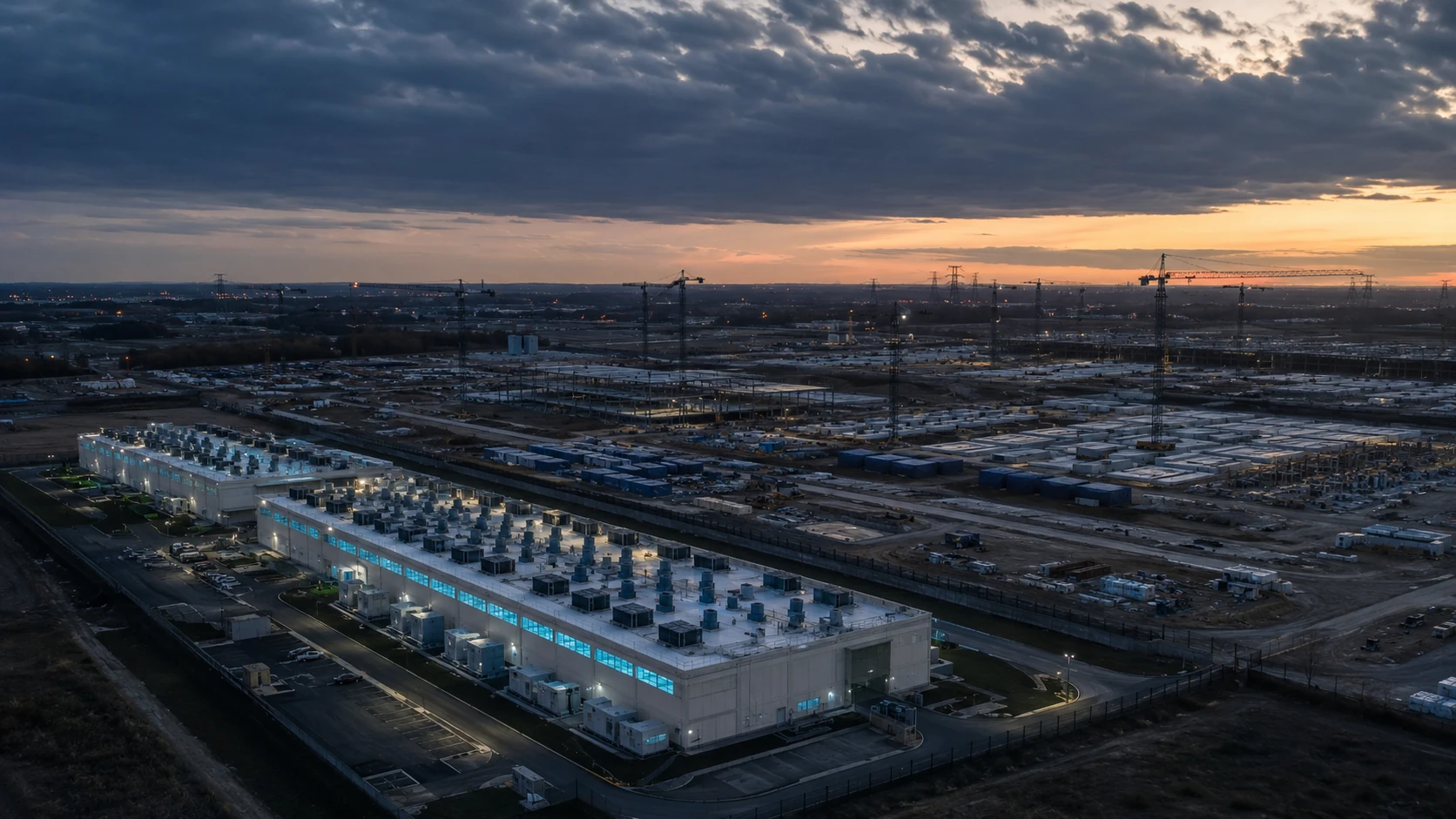
AI industry financing, capex, and physical build-out drifted during 2025–2026 into a scale with no precedent in prior technology cycles. Hyperscalers have committed to investment levels approaching a trillion dollars, two labs — OpenAI and Anthropic — are raising over $220 bn in funding in less than two years, and at the same time the physical data center base is growing clearly slower than the public narrative suggests.
This analysis examines the situation from the perspective of structural anomaly: why the AI industry does not behave like the dot-com era, like cloud build-out in the 2010s, or like any other large technology capex cycle. Source material includes BBC World News’s Anthropic interview and the Tech Report podcast’s broader data center survey — both public journalistic material.
FaktumAI perspective: We do not treat this as a forecast or investment advice. We examine structural scale and its consequences for the Finnish IT, data center, and cloud landscape.
Key figures at a glance
≈ $800 bn
Hyperscaler capex 2025
Microsoft, Google, Amazon, Meta
≈ $52 bn
AWS 2002–2017 total
birth of the entire cloud industry
≥ $220 bn
OpenAI + Anthropic, 2025–2026
funding in 18 months
$30 bn
Anthropic, latest round
valuation $900 bn
18–36 mo
Data center construction time
GPU generation 18–24 mo
≈ $1 trillion
NVIDIA 2027 target
GPU sales
Five structural anomalies
The surface-level question “is AI a bubble?” is the wrong question at this point. What matters is that the industry’s structure clearly diverges from what markets know how to price based on prior data. We identify five recurring contradictions in the source material.
1. Capex has detached from both revenue and deployment
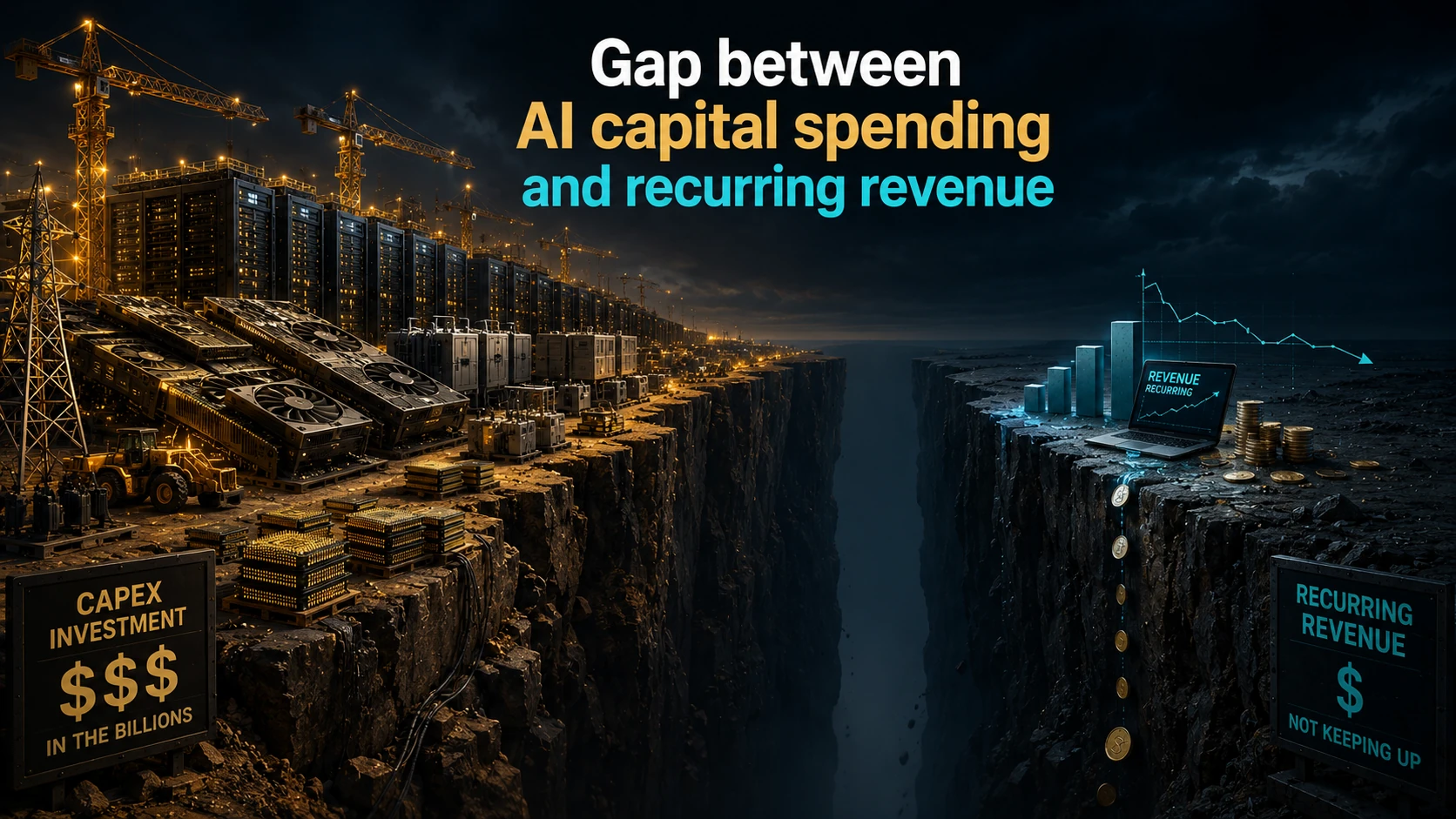
The combined 2025 capex of the four largest hyperscalers is roughly $800 bn. For comparison, all of Amazon Web Services was built between 2002 and 2017 for about $52 bn. A single year of AI capex thus exceeds the total cost of creating the modern cloud by nearly twelvefold.
This alone does not make the situation a bubble. Cloud was once suspect too. The distinguishing factor is that physical capacity does not follow financing: the “gigawatt data center” familiar from public discussion remains, for now, a concept without a completed counterpart. In hyperscaler communications, construction phase and operational phase blur together, and “operational” can mean either a single building or dozens of buildings within the same project.
Based on editorial mapping, the deployed share falls clearly below half of what is announced. This is an estimate emerging from the source material, not an audited figure — but its magnitude explains why NVIDIA shipments and data center completions do not tell the same story.
2. Time horizons do not align
The core contradiction in the AI industry is temporal:
- GPU generations turn over roughly every 18–24 months (H100 → Blackwell → Vera Rubin → next).
- Building a hyperscale-class data center takes 18–36 months once permits, power, water, cooling, and networking are included.
In practice, this means that when a data center is completed, the GPU generation planned for it is already the previous one. This is a structural difference from dot-com-era fiber networks: dark fiber aged slowly and activation was relatively inexpensive. An AI-class GPU, by contrast, is effective for only a few years, after which its resale value collapses because use cases for parallel processing outside generative AI are limited.
3. Demand is concentrated in two players
A large share of hyperscaler AI revenue comes from two end customers:
- Most of Microsoft’s AI revenue is OpenAI compute plus Microsoft 365 Copilot revenue on top.
- The dominant share of Amazon’s AI revenue is Anthropic compute.
- Over 70% of CoreWeave’s revenue sits with OpenAI.
This is an exceptional market configuration. In a normal cloud business, the customer base is fragmented across thousands of companies; in AI cloud, two labs carry the majority of the order book. If either faces a binding capacity or financing constraint, the effect shows up immediately in the quarterly results of the hyperscaler funding it.
4. Funding rounds are structurally circular
Capital flows within the ecosystem are partly internal:
- NVIDIA invests in AI labs and their cloud partners (CoreWeave, Lambda, Nebius).
- Microsoft, Google, and Amazon fund OpenAI and Anthropic while those labs buy compute from them.
- Anthropic’s latest round ($30 bn) is largely routed back into compute purchases.
This is not necessarily illegal in accounting terms, but it makes traditional metrics — revenue, margin, ARR — difficult to interpret. When the same dollar passes through two or three company balance sheets, “growth” can appear before end demand has materialized.
5. Market scrutiny is voluntarily deferred
The most structurally anomalous trait of the AI industry is what does not happen: leading AI companies do not go public even though market conditions would be exceptionally favorable.
- Anthropic’s secondary-market valuation has swung between $1.2–1.4 trillion.
- OpenAI’s primary financing has continued through private rounds.
- Both companies’ CFOs have publicly stated that the company is “not ready for public market scrutiny.”
When a company valued at a trillion dollars openly signals that it is avoiding the transparency an S-1 filing would bring, this is not a normal growth-company situation. Private markets allow higher valuations with less reporting obligation, which lets the narrative continue longer than it could on a public exchange.
Data centers — the physical tip of the bubble
The most detailed section of the source material concerns data center completion. Several frequently cited “flag-raising projects” are only partially operational:
| Project | Public description | Deployment observation |
|---|---|---|
| Project Rainier (Amazon × Anthropic, Indiana) | “fully operational” | 7 / 30 buildings active |
| Stargate Abilene (Oracle × OpenAI) | “operational” | 1 → 2 buildings over ~6 months |
| Microsoft Fairwater (Atlanta, Wisconsin) | in operation | first phase in use |
| Anthropic × Colossus 1 | new capacity | 300 MW of older H100/H200 hardware |
Anthropic’s Colossus 1 lease is a structural signal: if new capacity had been available from hyperscaler partners, the lab would not have moved quickly to a built-out data center based on an older GPU generation. 300 MW is globally significant only because completion of other hyperscaler projects has been delayed.
Individual project build-out stages are editorial readings of third-party source material. Final figures require verification against official financial statements and local permits.
The scale of financing
Combined funding for OpenAI and Anthropic since the start of 2025 has exceeded $220 bn. This is a magnitude not seen in venture and growth financing history.
This should be set in context: Anthropic raised $75 bn in six months. The company’s working capital is consumed essentially by compute purchases — in other words, a large share of funding returns to hyperscaler partners’ revenue. This is part of the structural circularity discussed earlier.
The tension between revenue and “lifetime” figures
Anthropic communicates roughly $50 bn ARR and a $4 bn monthly figure publicly. At the same time, the CFO’s sworn statement on March 6, 2026 in the Department of War litigation referred to roughly $5 bn in cumulative revenue over the company’s entire history.
These figures are not automatically contradictory — annualized run rate and cumulative deployment are different metrics — but reconciling them requires explanation that public communications have not yet provided. This is precisely the metric an S-1 filing would require, and one reason listing is being deferred.
What distinguishes this from prior bubbles?
The dot-com comparison is partly misleading. We consider the structurally significant differences to be:
| Feature | Dot-com 1999–2001 | AI cycle 2025–2026 |
|---|---|---|
| Capex target | Fiber networks, server rooms | GPUs, gigawatt campuses |
| Depreciation pace | Slow (fiber 25+ years) | Fast (GPU useful 3–5 years) |
| Activation cost | Relatively inexpensive | High — requires a new data center |
| Customer concentration | Fragmented | 2 labs dominate demand |
| Funding source | Public markets, IPO boom | Private credit, hyperscalers, NVIDIA |
| Scrutiny | Public markets | S-1 deferred, secondary market |
The conclusion is not “the same bubble, bigger.” It is a different structure, whose unwinding may happen through different mechanisms and on a different timeline than in the dot-com era. This is why analytical tools from the 2000s produce contradictory signals.
Technical assessment for the Finnish builder
The situation does not put Finnish IT teams into panic mode, but it shifts infrastructure strategy priorities:
- Model-provider portability is worth building into architecture from the start. If OpenAI or Anthropic faces a capacity constraint, the effect shows up in API latency and pricing before public news.
- Cloud-provider portability follows the same logic: at the hyperscaler level, AI revenue does not resemble a traditional cloud customer base.
- Local inference should be kept as a realistic option — the role of Nordic data centers and domestic GPU renters grows as hyperscaler capacity is steered toward the largest customers.
- Capex and depreciation reporting should be read from hyperscaler financial statements as carefully as model benchmarks. Depreciation at the quarterly level will move significantly over the next 18 months.
- Long API commitments should be priced with risk in mind. Prepaid credits are currently a structurally popular way to inflate reported demand.
Risks and uncertainties
- Actual capex deployment (under $200 bn) is an estimate emerging from the source material, not an audited figure. Its magnitude is nonetheless consistent with hyperscaler GPU delivery data.
- Build-out stages of individual data center projects require verification against official financial statements and local permit records before final conclusions.
- Anthropic revenue figures may include different revenue recognition practices (including pre-sale of API credits) that are not directly comparable to SaaS MRR.
- This article does not take a position on individual companies’ bankruptcy risk or stock direction. The focus is on structural imbalances.
Conclusion
The AI industry is not the new internet, and it is not the new cloud. It is structurally a new form of business in which:
- capital runs ahead of physical capacity,
- demand is concentrated in two end customers,
- financing circulates within the same ecosystem,
- time horizons do not align, and
- public scrutiny is deferred indefinitely.
Any single one of these five traits does not make a bubble inevitable. Their simultaneous presence does. A market where all five appear at once behaves historically differently from a healthy growth cycle — both in the upswing and when it ends.
From the perspective of the Finnish builder, buyer, and investor, this means infrastructure and financing must be read together. Model benchmark lists and API price sheets are the surface. Beneath them lies the question of who pays for the next gigawatt — and when that gigawatt actually comes online.
Sources
- 1. AI Bubble: Everyone is aggressively avoiding reality — Tech Report / Better Offline (Ed Zitron interview), 2026
- 2. Anthropic $30 Billion Funding Round (Business Today) — BBC World News, 2026
FaktumAI note: This article is based on the listed sources. Points that could not be verified from an independent source are marked as uncertain.