There isn't enough revenue to pay for the AI being built
FaktumAI analysis of Ed Zitron's May 2026 Tech Report interview — why hyperscaler revenue math, hidden AI numbers, and OpenAI's IPO rush point to the same structural gap.
What happened?
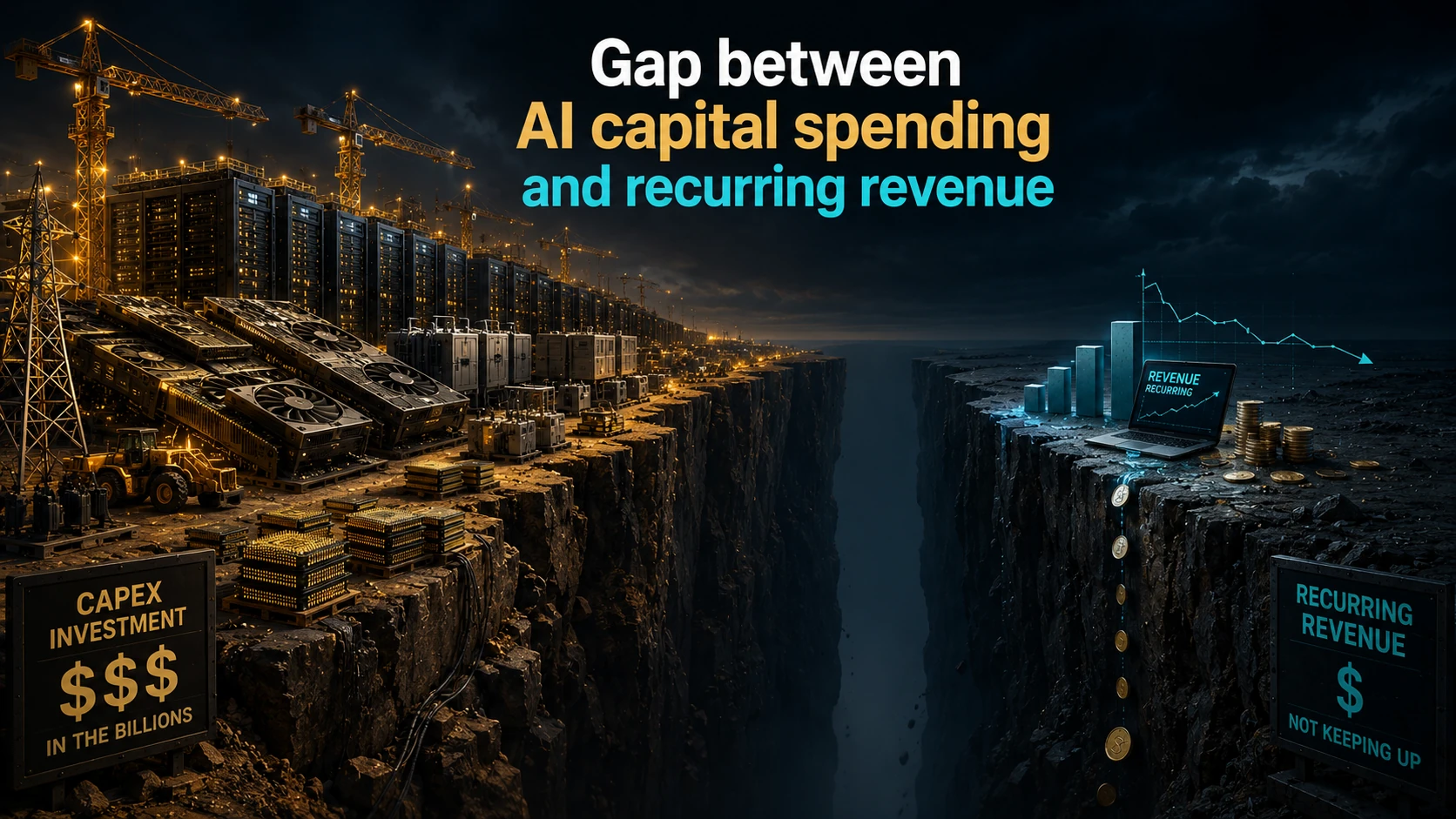
In a 22 May 2026 Tech Report episode, Ed Zitron (Where’s Your Ed At, Better Offline) tells host Isaac Pound that the AI build-out has an arithmetic problem: spending is real, recurring revenue is not. The conversation opens on Sam Altman’s push toward an OpenAI IPO as soon as September 2026 with a hoped-for $1 trillion valuation — then pivots to what Zitron calls the impossible maths behind the boom, including an FT piece by an investment banker that, in his view, finally states what he had been arguing for months: Microsoft, Meta, Amazon, and Google would need to roughly triple AI-era revenue growth or the bubble breaks.
Zitron’s core claim is not that AI is useless. It is that even AI optimists cannot explain where hundreds of billions in new, reliable software revenue comes from — on top of existing cloud and workspace businesses — while hyperscalers simultaneously hide AI numbers and race to spend $800–900 billion in CapEx in 2026, with ~$1 trillion cited for 2027.
FaktumAI view: This is a second lens on the same capital cycle we covered in the earlier Zitron data-center interview and structural bubble analysis. Where the first piece asked where GPUs go, this one asks who pays for them twice. Treat interview figures as signals for scrutiny, not filing-ready facts.
Key figures
~$200 bn
New AI revenue needed (each, approx.)
Zitron cites the Financial Times — a new AI business as large as Google Search or Azure
~$600 bn
Combined new AI revenue
Rough total across Google, Microsoft, Amazon in the interview
~$37 bn
Microsoft AI run rate
Annualized figure cited — month not disclosed
$800–900 bn
Hyperscaler CapEx (2026 est.)
Zitron; ~$1T cited for 2027
Sep 2026 / $1T
OpenAI IPO (hoped)
Altman target cited in interview
$300M
Salesforce Anthropic tokens (2026)
Benioff quote — won't need to in the future
$ bn
Why this matters for the Finnish reader
Finnish teams usually operate at the edge of this cycle: Copilot pilots, cloud bills, vendor roadmaps — not trillion-dollar CapEx programs. That distance is useful. If global AI revenue math is weaker than hyperscaler earnings calls imply:
- Cloud and API pricing may stay subsidized longer, then snap — affecting Finnish SaaS and enterprise budgets.
- Vendor “AI transformation” sales can outrun customer ROI; procurement needs outcome metrics, not token dashboards.
- EU AI Act employment and transparency rules matter more when vendors push performative usage to justify spend (see our Gartner/Bernal productivity analysis).
- Public-sector and mid-market buyers should not treat US hyperscaler narratives as proof that local AI spend will pay back on the same timeline.
The revenue gap: what the FT framing adds
Zitron walks through a scale comparison, not a precise forecast:
| Company | What “success” would look like (interview) | Reported AI scale cited |
|---|---|---|
| Another Google Search — ~$200 bn/year in new AI-specific revenue | Not disclosed with same precision as Search | |
| Microsoft | One or two Azures — ~$70–140 bn | ~$37 bn AI run rate (month unclear) |
| Amazon | Another AWS — ~$128 bn/year | Mostly Anthropic-linked; ~$15 bn AI revenue in prior Zitron math |
He rounds to ~$200 bn each and ~$600 bn combined in new AI revenue — on top of existing businesses. Microsoft, he estimates, already makes ~$300 bn/year; the boom still assumes another $200 bn, not a replacement of current lines. His point: customers would still pay for all existing software and cloud spend and find new money for AI — e.g. office suites, AWS, and Azure.
Global software industry revenue is only ~$700–800 bn/year in his estimate. The boom therefore requires inventing a new industry inside software, not reallocating existing spend — unless every buyer simultaneously increases budgets with new money from somewhere else.
”Watch the hands, not the mouth”
A recurring theme: traditional units are reported precisely; AI is a riddle.
- Intelligent Cloud, Google Search, AWS — specific figures.
- AI revenue — run rates, narratives, shy trillion-dollar market caps.
Zitron’s read: when public companies have good news, they shout. AI’s vagueness is evidence that the gold mine is not visible yet — consistent with his circular financing picture (OpenAI ↔ Microsoft ↔ NVIDIA ↔ labs).
Growth rate check: he argues you’d need roughly 50% year-over-year growth every quarter for several years to begin closing the gap. That pattern is not showing up in disclosed AI lines — even before skepticism about margins or GPU depreciation.
CapEx now, revenue later, chips obsolete sooner
Hyperscalers are cramming CapEx because:
- Wall Street may curdle — spend while markets still believe.
- Data centers take 18–24 months minimum — if you believe AI is big in two years, you must build now.
But Zitron adds a hardware cycle problem: even if magical new AI businesses appeared overnight, A100s and Blackwell GPUs may not pay back before Vera Rubin (or the next generation) replaces them. Optimistic and pessimistic cases converge on a wash — unless revenue arrives fast and at scale, which he says is absent.
Amazon-specific constraint: AWS is infrastructure-first with Anthropic as the dominant AI customer story. If Amazon cannot build capacity, it cannot grow revenue at the required rate — software upsell is not Amazon’s play in this framing.
Enterprise spend: token burn without a budget story
Cloud computing matured with clear line items: ERP, storage, design tools — measurable ROI narratives. Zitron contrasts that with Anthropic-style enterprise use:
- Hard to attribute cost per user (granularity limits cited).
- No standard SLA in the story he tells — unusual for enterprise software.
- CFO quotes in press stories: “still working this out”, “can’t last”, budgets blown in a quarter.
Salesforce example: Mark Benioff reportedly plans $300 million on Anthropic tokens in 2026 but says the company “won’t need to do this in the future.” Zitron’s read: that is not the setup for a stable, growing industry — it is experimentation at scale.
This connects to Natasha Bernal’s productivity interviews: the goal of work shifts from business outcomes to proving the AI budget was worthwhile.
Management theater and the “business idiot thesis”
Zitron names a provocative frame — the economy caters to people disconnected from production (executives, some managers, VCs). For people whose work is email, meetings, and posts, LLMs feel like work itself. That produces:
- Performative AI adoption to please bosses (metaverse parallels: Horizon Worlds meetings nobody wanted).
- Pressure on builders below to simulate AI value rather than ship outcomes.
FaktumAI strips the insult but keeps the mechanism: when evaluation rewards AI theater, teams optimize visibility, not software. Finnish readers with strong union and privacy culture may push back earlier — but vendor sales decks still import US narratives.
OpenAI IPO: exit before scrutiny
Pound asks the obvious follow-up: if Altman rushes IPO in 2026, does he know the math is impossible?
Zitron’s answer:
- Stay private while you can maximize IPO pop; rush the door when private markets are tapped out.
- WSJ (26 April) cited in the interview: OpenAI CFO Sarah Friar did not think the company ready for public-market scrutiny — yet September IPO talk continues. He calls that desperation, not confidence.
- SpaceX IPO competition and SoftBank exposure (Bloomberg stories referenced) add investor pressure to dump risk onto public markets.
Once public, real economics matter more; raising on story alone gets harder — see also OpenAI’s compute wedge.
NVIDIA: concentration and circular money
~$81 bn quarterly revenue (figure cited) with >60% from three customers, per Zitron: if any hyperscaler pauses, NVIDIA drops. For NVIDIA to keep growing, others must keep buying GPUs that are not fully deployed yet.
He points to NVIDIA’s 10-Q: cash up even while investing in AI companies — the circular financing loop continues (detailed in the prior Zitron piece). Meta spending heavily without a clear AI software story is another stress point in the interview.
Macro trap: growth tied to CapEx
Zitron cites a statistic — AI/tech investment over ~90% of US economic growth in FY2025 — without pinning a primary source in the interview. If true even directionally, hyperscalers cutting CapEx could hit enterprise software demand via recession — a feedback loop that makes slowing spend dangerous, not easy.
He still expects CapEx cuts eventually when data centers are started but not finished and regulators (Google antitrust example) might have changed behavior if they had acted earlier.
Technical assessment for builders
For engineering and product leaders:
- Demand proof, not run rates. Ask vendors for customer-level ROI, not annualized AI lines with missing months.
- Separate pilot spend from platform bets. A $300M token line that leadership says is temporary is a feature experiment, not a P&L strategy.
- Model CapEx exposure in vendor risk. Concentrated GPU supply chains affect latency, price, and roadmap slips for Finnish teams on US clouds.
- Document outcomes before AI quotas. If finance cannot explain Anthropic bills per team, your org is in irrational exuberance territory.
For individual contributors:
- When leadership asks for AI visibility, ask what outcome replaces last year’s metric.
- Treat IPO narratives as capital events, not product maturity signals.
- Prefer employers who measure merged work and incidents resolved, not Copilot hours.
Risks and uncertainties
- FT, WSJ, Bloomberg, 10-Q references — verify originals before citing in business cases; this article follows Tech Report commentary.
- Run-rate definitions — Microsoft $37 bn depends on undisclosed month; Amazon $15 bn comes from prior Zitron interview cross-talk.
- $90% US growth — source not named in episode; treat as directional only.
- Overlap with
ed-zitron-ai-kupla— same guest, different emphasis; read both for deployment vs revenue angles. - Bubble timing — Zitron guesses 6–12+ months of narrative inflation; not a forecast.
Conclusion
Zitron’s May 2026 interview compresses the AI boom into one line: the tech industry is being asked to double revenue in four years, and nobody shows where the new money comes from. Hidden AI numbers, Salesforce-style temporary token budgets, NVIDIA customer concentration, and OpenAI’s IPO hurry are different faces of the same gap — capital deployed faster than honest revenue.
For executives: if your AI strategy assumes hyperscaler economics will “figure themselves out,” build local ROI proof anyway. Watch the hands — customer churn, margin, and payback — not keynote adjectives.
For builders: the next skill is not prompt theater; it is translating AI spend into durable product metrics your CFO can defend without a vision quest.
Solo developer perspective
Good: Clear scale comparisons ($200 bn vs $37 bn) help you push back in architecture reviews when someone says “everyone is making money on AI.” Performative adoption now has a name — easier to ask for outcome KPIs.
Bad: Token pricing and API bills can explode without per-feature attribution; junior roles shrink while AI theater grows in job postings.
Worth learning: Run private before/after benchmarks on real tasks; read EU AI Act employment guidance before accepting scoring tools; keep a paper trail of shipped work if promotion criteria shift to AI usage stats.
Pair with data-center deployment analysis, OpenAI compute wedge, and workplace productivity crisis.
Sources
- 1. AI Bubble: There isn't enough to pay for the amount of AI being built — Ed Zitron — The Tech Report — Ed Zitron, 2026-05-22
- 2. Impossible maths behind the AI boom (FT piece cited in interview) — Financial Times, 2026
FaktumAI note: This article is based on the listed sources. Points that could not be verified from an independent source are marked as uncertain.