The AI bubble does not survive this question
The question the entire interview revolves around: where do all those GPUs and data centers actually go? Analysis of Ed Zitron's Tech Report interview — hyperscaler circular financing and data center deployment.

What happened?
Ed Zitron (Where’s Your Ed At?, Better Offline podcast) argues that the AI bubble does not survive one question: where do all those GPUs and data centers actually go? According to the Tech Report interview, the current AI boom is structurally NVIDIA’s revenue model, funded by hyperscalers, labs, and investors extending arranged credit to one another — not by real, broadly distributed compute demand.
FaktumAI note: This article is an editorial summary and analysis of the interview. All claims and figures are drawn from the provided source material; nothing has been added from outside the interview. Readers should evaluate the claims independently and verify critical figures from original sources.
Key figures
≈ $300 bn
OpenAI + Anthropic servers (estimate)
Zitron's calculation from the interview
$7.6 trillion
Goldman Sachs AI build-out 2031
Tracking Trillions report
$1 trillion
Hyperscaler capex 2026
Meta, Google, Amazon, Microsoft
6 million
NVIDIA GPUs / year
Last year's shipments per the interview
Why this matters for the Finnish reader
In Finland, AI investment targets cloud services, data centers, and corporate experimentation. If Zitron’s claim holds even partly, capacity pricing, availability, and capital market risk directly affect:
- IT professionals’ cloud and GPU budgets
- startup and scale-up funding rounds
- public sector procurement (cloud vs. local compute)
- students’ and builders’ access to cheap inference
Main claim in one sentence
According to Zitron, the AI bubble does not survive a simple question: where do all those GPUs and data centers actually go?
“Every time you look for the supposed gold mine, you find only someone handing money to someone else — not gold.” — Ed Zitron
He says he spent days searching for real compute capacity customers without success. The market has, in his view, moved away from reality.
Structure of the bubble
- OpenAI and Anthropic have been treated like “rich kids” — efficiency or profitability has not been demanded the way it is from normal companies.
- Microsoft effectively built OpenAI’s infrastructure; Amazon and Google backed Anthropic. Hyperscalers are, according to Zitron, in practice a large part of demand.
- OpenAI received A100 GPUs at cost in its early years (The Information, summer 2024).
DeepSeek warning (January 2025): Zitron interprets the message not as “China can do more with less,” but as no one needs as many GPUs as OpenAI and Anthropic use. Example: Perplexity — at most a few hundred or a thousand GPUs.
Who actually rents compute?
Zitron searched for a week for customers of large GPU capacity. Recurring players found:
| Customer | Where compute comes from |
|---|---|
| OpenAI | Microsoft, Google |
| Anthropic | Amazon, Google, Microsoft, XAI Colossus One |
| Jane Street | Hedge fund — invested in CoreWeave |
| Meta | For itself — Zuckerberg’s “AI psychosis” |
XAI’s Colossus One (300 MW) was leased entirely to Anthropic — a signal that Amazon, Google, and Microsoft are not bringing new capacity online in the near term.
AI revenues are OpenAI and Anthropic
One of the interview’s strongest numbers concerns hyperscaler AI revenue (annualized, per the interview):
- Microsoft $37 bn — OpenAI’s share 70–80% (remainder M365 + GitHub Copilot before token billing)
- Amazon $15 bn — Anthropic ≥ 80%
- CoreWeave — OpenAI over 70% of revenue
- Microsoft × Nebius — effectively OpenAI compute
“If OpenAI falls, everything falls” — Zitron’s interpretation of the market not yet understanding the dependency.
Big numbers — commitments and collateral reserves
- Goldman Sachs Tracking Trillions: AI build-out cost $7.6 trillion by 2031
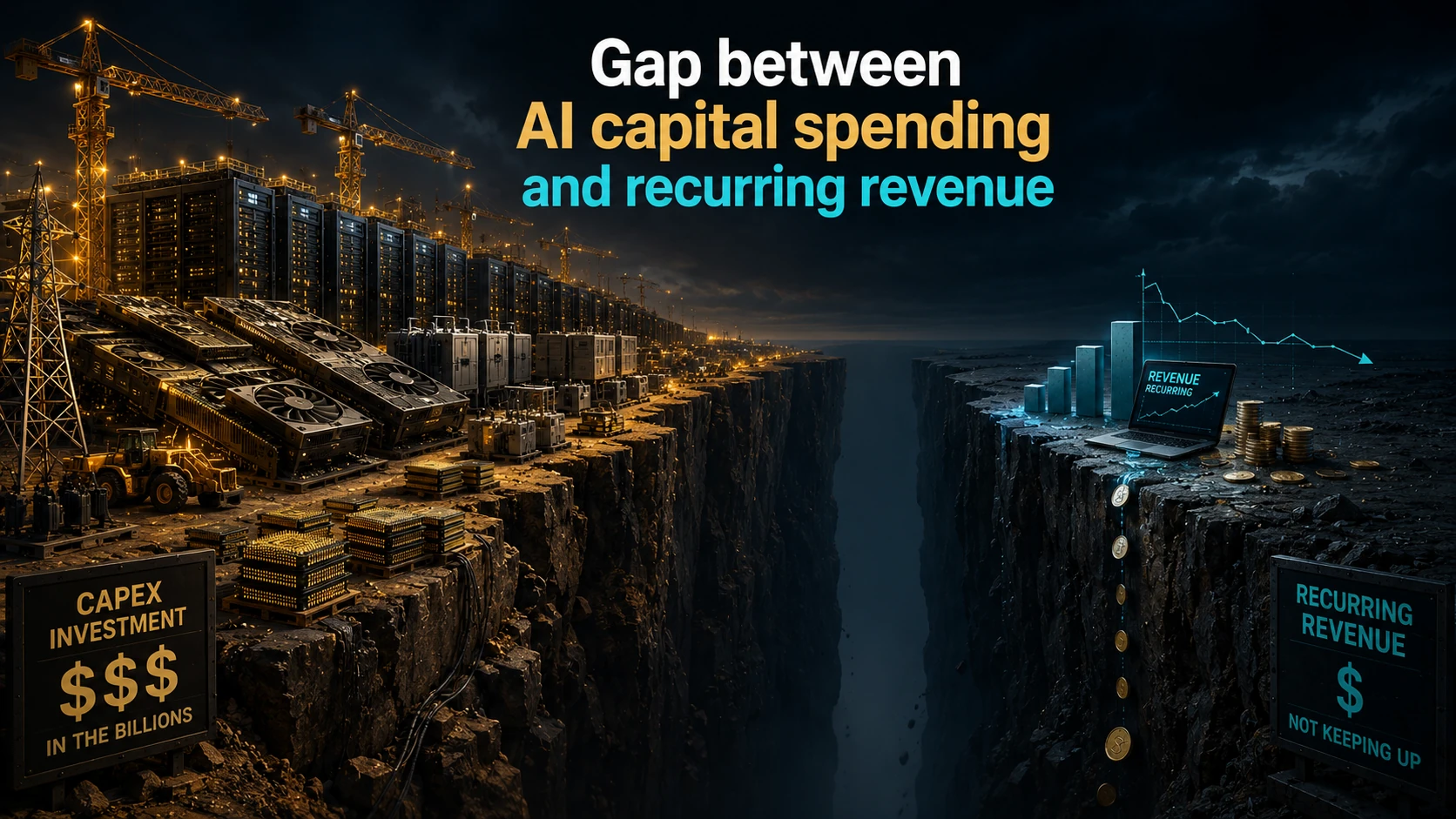
- Hyperscaler capex $800–900 bn (2025) and $1 trillion (2026) — Meta, Google, Amazon, Microsoft
- OpenAI compute cost $50 bn (2025) — not profitable per the interview
- $748 bn of Microsoft + Google + Amazon order book is future revenue from OpenAI and Anthropic
- Additional funding need for OpenAI + Anthropic: $400 bn (Zitron’s estimate)
Goldman Sachs notes in the interview that AI costs most companies more than it saves. OpenAI and Anthropic are losing tens of billions per year.
Anthropic financing (per the interview)
- Ongoing round $50 bn, prior valuation $380 bn
- 37 investors in the previous round
- $108 bn in committed funding over the last five months
- Anthropic claims $45 bn annualized revenue; Zitron suspects pre-sale of API credits
OpenAI (per the interview)
- Needs over $800 bn by 2030
- Broadcom chip deal (10 GW, 2029) has not progressed
- SoftBank marginal loan to OpenAI: $15 bn → $6 bn
- Google $10 bn + option $30 bn; Amazon $5 bn + option $20 bn
Data centers — the bubble’s hard question
“Go try to find a finished data center that was announced in 2023. Just try. I tried.” — Ed Zitron
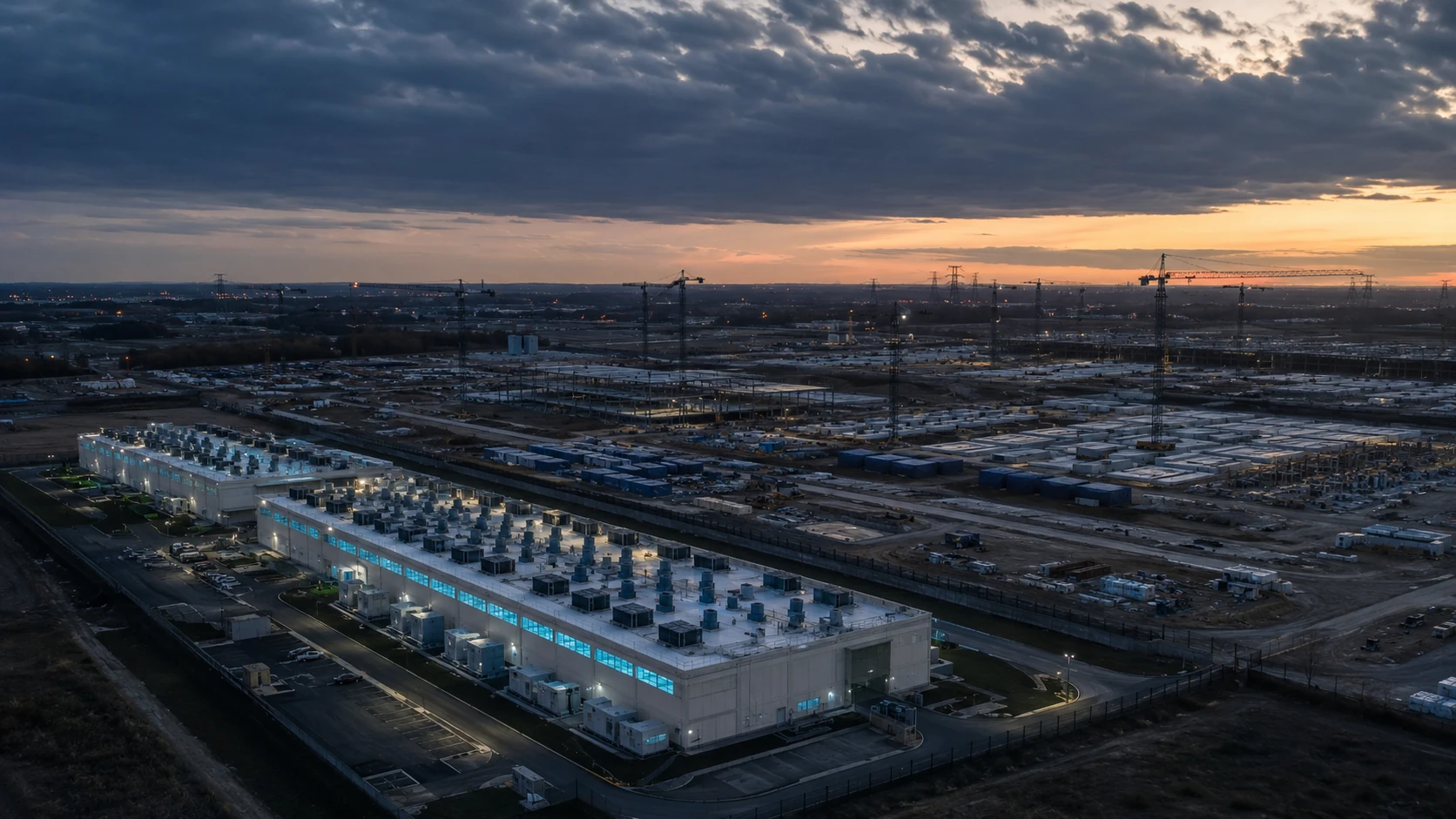
- Microsoft claimed to have built 1 GW of capacity per quarter; according to Zitron’s mapping, not a single announced project is complete
- Sightline Climate claims 5 GW built last year; Zitron believes the reality is hundreds of megawatts, not gigawatts
- Colossus One (300 MW) leased to Anthropic — with older H100/H200/GB200 GPUs
- Microsoft did not respond to a comment request within three days
Fate of the GPUs: NVIDIA expects $1 trillion in GPU sales by end of 2027. Zitron’s question: where are the rest if they are not installed in data centers?
Obsolescence risk: Blackwell GPUs that cannot be installed before the Vera Rubin generation may go unprovisioned.
Banks and private credit
- Financial Times: banks selling AI debt at a discount
- No debt → no data centers → no GPU sales → NVIDIA numbers down
- 113 GW of committed capacity by 2030 — requires continuous leverage
- $1 trillion in private credit (insurance, pensions, 401k) — Apollo, Blackstone, Vanguard
Circular financing
Zitron proposes three rules in the interview:
- Circular financing should be prohibited
- Contract revenue that cannot be collected within 12 months should not be reported
- Principal counterparties (e.g. NVIDIA) should not invest in their customers (Iron, Nebius, CoreWeave, Lambda)
NVIDIA is deploying $27 bn in cloud compute through 2032 — renting its own GPUs back.
Comparison to past bubbles
| Comparison | Zitron’s point |
|---|---|
| AWS | 2002–2017, $52 bn for the entire period, profitable in the end; equivalent burned in AI compute in one year |
| Dot-com | ”Big free cash flow” does not hold — FT: $20–30 bn → $4 bn in the near term |
What pops the bubble?
Zitron believes a small signal is no longer enough. Likely triggers:
- Payment fails from OpenAI or Anthropic
- A funding round does not close
- NVIDIA misses its forecasts
- “Three data center horsemen”: data center under construction is canceled, planned data center is canceled, operating data center shuts down
- A report shows only gigawatt-scale deployment vs. tens of gigawatts committed
“If it turns out data centers are not being built, the question becomes: why did we buy all these GPUs?” — Ed Zitron
Technical assessment
From an AI builder’s perspective, the interview emphasizes capacity price and availability risk: if demand is concentrated in a few players, smaller teams still benefit from efficient models (DeepSeek-type message), but cloud price dynamics can swing sharply if financing or narrative shifts.
In Finland this means: do not tie your entire strategy to one cloud provider or one model provider without an exit plan; follow capex and debt news as closely as model benchmarks.
Risks and uncertainties
- All figures come through the interview and Zitron’s interpretations; companies have not commented on all claims
- Data center project deployment requires independent mapping
- Anthropic and OpenAI revenue figures may include credit bookings not comparable to traditional SaaS
- Regulatory and legal proposals are opinions, not facts
Conclusion
According to Zitron, the AI boom is fundamentally NVIDIA’s revenue model: hyperscalers and labs lose money but keep the machine running on one another’s financing. When data centers do not finish, demand cannot be found and debt accumulates — what is the final outcome of this structure?
For the Finnish reader, this is a signal to follow infrastructure and financing as seriously as model benchmarks.
Sources
- 1. The AI bubble won't survive this question — Ed Zitron — Tech Report / Better Offline podcast, 2025
FaktumAI note: This article is based on the listed sources. Points that could not be verified from an independent source are marked as uncertain.